
شهر و معماری تاریخی کرمان - دانشکده معماری arch
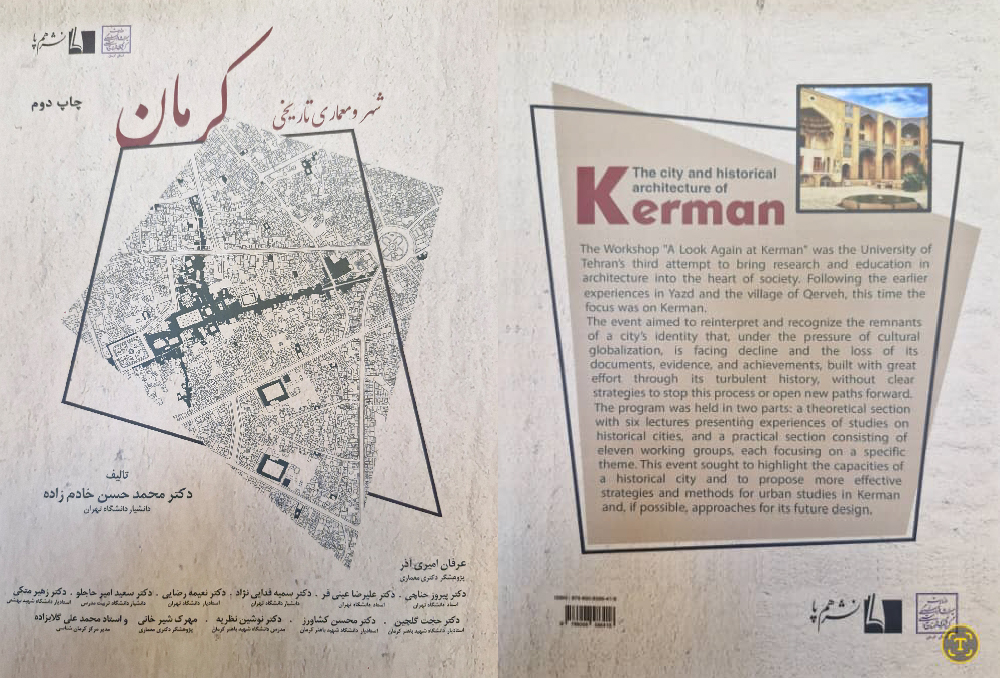
The city and historical architecture of Kerman
Authors: Mohammad Hasan Khademzadeh, Erfan Amiriazar, Pirouz Hanachi, Alireza Eynifar, Sommaye Fadaeinejad, Naeime Rezaei, Saeid Amirhajiloo, Zahir motaki, hojat Golchin, Mohsen Keshavarz, Noushin Nazarieh, Mehrak Shirkhani, Mohammad A. Golabzadeh
Publisher: Ham_pa Publishing
Publisher: Ham_pa Publishing
Description
The present book is the outcome of the workshop “A New Look at the Historic City and Architecture of Kerman.” This workshop represents an effort to re-examine and rediscover the remaining elements of a city’s identity—an identity that is gradually dissolving under the pressures of cultural globalization. Kerman has witnessed the destruction of its own documents, evidence, and achievements, all of which were painstakingly built and refined over a long and turbulent history, without having devised solutions to confront this situation or opened a path to prevent further loss.
Kerman, once a shining manifestation of Iranian civilization—from the Halilrud and Shahdad cultures, to Qal‘eh Dokhtar and Qal‘eh Ardeshir, and even to the perseverance of its people in supporting the ruler’s son during the era of a united Iranian land—possesses a reputation far greater than its collapsed historic buildings and fractured walls. Expectations for Kerman were much higher than what field observations ultimately revealed. Although the diminishing and erasing of human, national, and local identity currently casts a shadow over Iranian society as a whole, Kerman—like many other cities and villages—moves along a trajectory determined by rootless administrators and capital-driven decision-makers who operate at a distance from culture.
In line with the workshop’s primary goal—bringing architectural education into society—and its secondary goal of fostering a deeper understanding of the current state of Kerman’s cityscape and historic architecture, several thematic axes were defined. One part of the program involved presenting previous studies, while another centered on direct, on-site surveys and fieldwork throughout the city.
The results of these investigations are presented in the form of fourteen articles in this volume.