
رویکرد منظر - دانشکده معماری arch
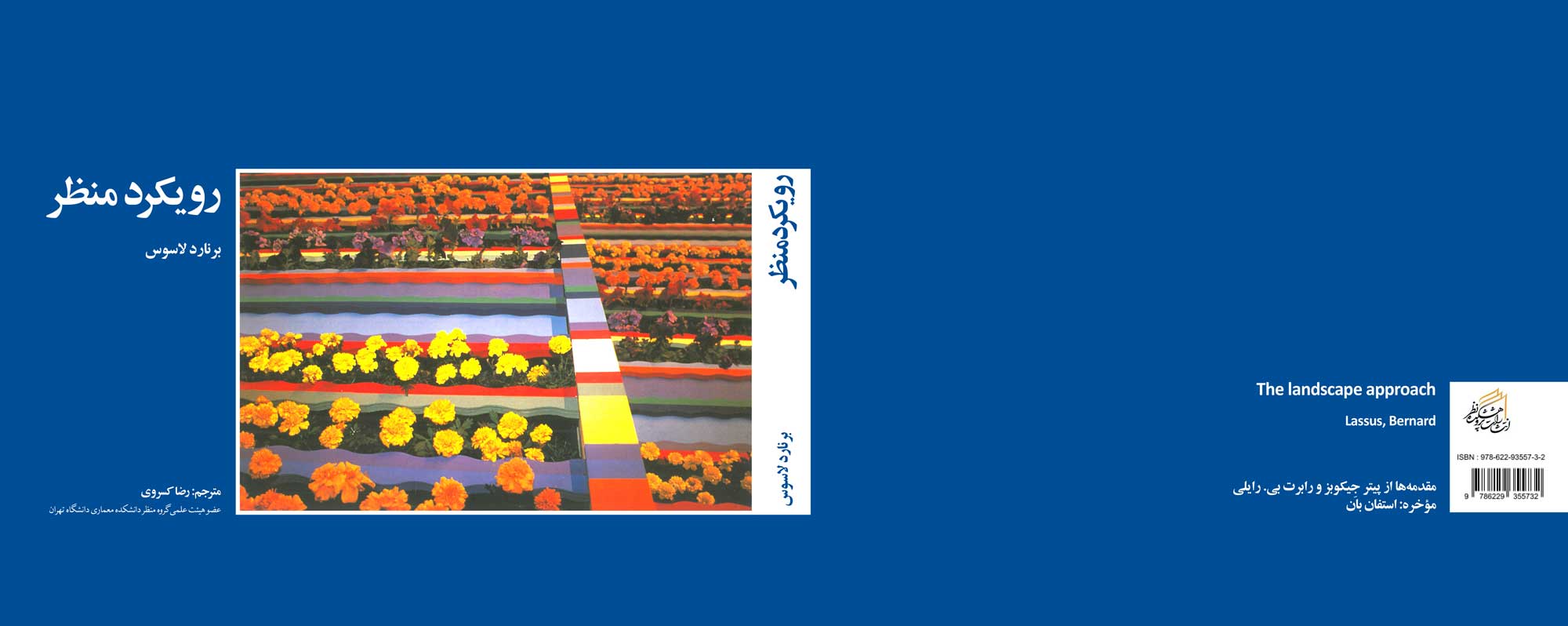
The Landscape Approach
Authors: Bernard Lassus
Translator: Reza Kasravi
Publisher: NAZAR Research Center of Art, Architecture & Urbanism
Translator: Reza Kasravi
Publisher: NAZAR Research Center of Art, Architecture & Urbanism
Description
Bernard Lassus was for many years a professor at the École des Beaux-Arts and the École Nationale Supérieure d’Architecture de Paris-La Villette, and has completed numerous garden and park projects. Having moved from the fine arts to landscape architecture, he began, in the mid-1960s, to formulate his ideas on environmental planning by introducing new dualities and questioning established ones. Lassus distinguishes between the tangible scale and the visual scale, explaining their respective implications in garden and landscape design. He defines measurability and immeasurability in landscape and clarifies that within landscape there are elements which, although they escape the measuring tools of the natural sciences, nonetheless possess a strong presence and demand attention.
He addresses notions of homogeneity and heterogeneity, questions familiar dualities such as contrast with the landscape versus integration into it, and, by articulating a third mode of intervention—which he terms minimal intervention—proposes a new approach to landscape. A defining characteristic of Lassus is his resistance to one-sided scientific perspectives and to the homogeneity-oriented approach of modernism—a view that, particularly in the mid-twentieth century, regarded architecture in general and landscape architecture in particular as ubiquitous, repeatable commodities, much like the International Style.
Lassus counters this perspective by creatively introducing imagination and history into the theoretical foundations of landscape, especially in response to the Cartesian separation of subject and object. To this end, he draws upon a broad range of studies in literature—especially poetry—philosophy, particularly phenomenology, as well as his background in painting. The present book is a translation of a curated collection of Lassus’s writings and lectures, compiled and presented as an independent volume.